Bocco vs Yazio: an honest comparison
By the Bocco team · 5 min read
The short version: Yazio and Bocco both let you log a meal from a photo — but that's where the similarity ends. Yazio built its name on a 16-protocol intermittent fasting timer and a food database licensed in part from Germany's official nutrient database, with search-and-barcode logging as the default path; AI photo scanning is a Yazio Pro feature you unlock on top. Bocco skips the layers: the photo is the app, and correcting an estimate is one sentence, not an edit form. Neither is "the better app" — Yazio is built around fasting plus a validated database, Bocco around getting a plate logged and corrected fast.
I went looking for what Yazio actually does well before writing this, and it's more than most comparison posts give it credit for — the fasting timer runs deep (16 protocols, tied directly to your food log), and the DACH-region food data has real institutional backing. What's worth knowing is which parts of that are free and which aren't, because it's not obviously either.
Yazio, in one line
A German-built tracker with real traction across Europe, known for its intermittent fasting timer and recipe library as much as calorie counting. If you want a serious fasting protocol built into your food log, Yazio has one of the better ones on the market.
The real difference: Yazio's AI photo scanner is a paid add-on; Bocco's is the front door
Open Yazio for the first time and the default way to log is still search or barcode — type the food, pick the closest match, or scan a package. Yazio does have an AI photo feature: point the camera at a plate and it estimates the ingredients and nutrition, which you then review and adjust before it's saved, according to Yazio's own Help Center. It's a real feature, not vaporware. But it sits behind Yazio Pro, and "review and adjust" in practice means editing individual ingredient rows — swapping quantities, retyping a mislabeled item — not describing the fix in your own words.
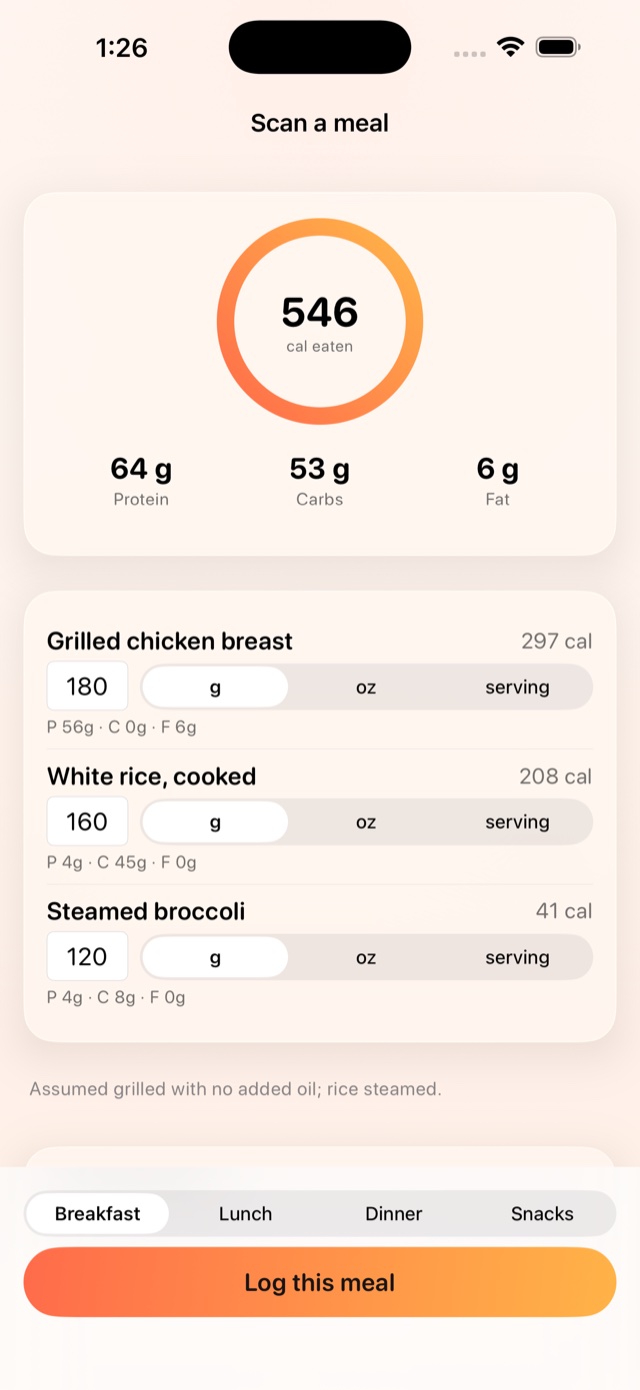
Bocco starts from the photo by default. You snap the plate, get an estimate of items, grams, and calories in one pass, and if something's off — a bigger portion, oil the app didn't catch, a different cut of meat — you say so in a sentence and the whole entry recalculates. No ingredient editor, no unlocking a tier first.
Neither approach is error-free, and estimating a plate from a single photo is a hard problem for any model. The difference is what it costs to get there and how you fix it when it's wrong.
What sits behind Yazio Pro
This is the part worth knowing before you pick a side: Yazio's free tier is ad-supported and covers manual search and basic logging, but the AI photo scanner, the barcode scanner, the fasting tracker, the recipe library, and meal plans are all Pro features, per Yazio's own explanation of what Pro unlocks. That's a reasonable way to fund a database this size — but it means the two headline features people come to Yazio for, fasting and AI photo logging, both sit on the far side of a paywall.
That's not a knock on Yazio's business model; a European nutrient database and an in-house AI feature both cost real money to run. It's just fair to know the free tier is thinner than the App Store listing might suggest.
Accuracy: what an independent study found
Yazio's strength is real but geographically specific. Its data for German, Austrian, and Swiss generic foods draws in part on the Bundeslebensmittelschlüssel (BLS) — Germany's official, government-maintained nutrient database, run by the Max Rubner-Institut and covering over 7,000 foods across 138 nutrients. That's a solid foundation for the DACH region, comparable to what USDA's FoodData Central does for the US.
But a study published in the journal Nutrition in March 2026 compared Yazio against NutriComp, a professional dietary-assessment tool with a validated database, across a set of real dietary records. It found statistically significant differences in estimated energy, carbohydrate, protein, and fat intake, and concluded that Yazio's reliance on non-validated, partly user-submitted entries — outside the BLS-backed core — limits how far you can trust it for clinical or research-grade tracking (ScienceDirect, 2026). For everyday tracking that's a different bar than clinical accuracy, but it's an honest data point either way: Yazio is more reliable for the foods its licensed database actually covers than for restaurant meals or custom recipes typed in by other users — a limitation Bocco's photo estimates share in their own way. Neither app should be mistaken for a lab scale.
Which should you pick?
- Yazio if you want a real intermittent fasting timer built into your log, a European-strength food database, and don't mind paying for the AI photo scanner and barcode reader.
- Bocco if you want photo-first logging as the default, not an unlock, and you'd rather correct an estimate in a sentence than edit an ingredient list.
Frequently asked questions
Is Yazio's AI photo scanner free?
No — it's a Yazio Pro feature. The free tier covers manual search-based logging.
Is Bocco a good Yazio alternative?
If you want photo-first logging without paying to unlock it, yes — but Yazio still wins if what you actually want is its fasting timer or recipe library.
Is Yazio's food database accurate?
Strong for DACH-region branded and generic foods, since it draws on Germany's official BLS nutrient database — but a 2026 peer-reviewed study found it diverged meaningfully from validated professional dietary software on energy and macros.
Does Yazio have a fasting tracker?
Yes — a 16-protocol intermittent fasting timer integrated with the food log. It's one of Yazio's most distinctive features, and not something Bocco tries to replicate.
Which has the bigger free tier?
Bocco's core photo-and-correct loop isn't paywalled. Yazio's free tier is ad-supported and reserves AI photo logging, barcode scanning, fasting, and recipes for Pro.
Related: Bocco vs MyFitnessPal · How accurate is AI calorie counting?