Intermittent fasting and calorie counting: do you need both?
By Artem Grebenkin, founder of Bocco · · 5 min read
The short version: intermittent fasting decides when you eat, not how much energy your body takes in — and weight change is still driven by that second number. Fasting can make it easier to land in a deficit without deliberately counting anything, because a shorter window naturally limits how much you eat. But it isn't a substitute for calories in versus calories out, and if your weight stalls on a fasting schedule, calories are still the thing worth checking first.
Here's how the two actually fit together.
What intermittent fasting changes — and what it doesn't
Intermittent fasting (IF) is a timing framework: 16:8 (eat within an 8-hour window), 5:2 (eat normally five days, cut calories sharply on two), alternate-day fasting, and a few variants in between. None of them specify a food or a macro. What they specify is a clock.
That distinction matters because it's easy to assume the fasting window itself is doing metabolic work — burning extra fat just by virtue of the clock. A 2024 randomized controlled trial from Johns Hopkins, published in Annals of Internal Medicine, tested this directly: 41 adults with obesity and prediabetes were split into a strict 8am–6pm eating window and a looser 8am–midnight window, both eating similar diets, for 12 weeks. Weight loss came out nearly identical between the two groups (Johns Hopkins Hub). The researchers' takeaway was blunt: it's the calories eaten, not the hours they're eaten in, that mainly drives the scale.
So IF doesn't rewrite the energy-balance math. What it does is change the conditions you're eating under — and that's often enough to change the number itself.
Why IF often lowers calories anyway, without you counting a thing
Compress eating into 6–8 hours a day and a few things tend to happen automatically: you skip a meal (usually breakfast), snacking windows shrink, and "just grazing" while cooking or watching TV loses most of its opportunities. None of that requires tracking — it's a side effect of the schedule.
That's a real reason IF works for a lot of people, and it shows up in the research too. A 2025 randomized trial highlighted by Harvard T.H. Chan School of Public Health compared 4:3 intermittent fasting — eating roughly 20% of usual calories on three non-consecutive days each week — against a standard continuous calorie-restricted diet over a full year. The 4:3 group lost about six pounds more on average than the calorie-restriction group (Harvard T.H. Chan School of Public Health). The likely explanation isn't a metabolic edge — it's that the fasting structure made a deficit easier to hit and stick with, for people who find "eat less every day" harder than "eat much less on specific days."
In other words: IF can be one way to reach a calorie deficit. It's just not a way around needing one — and for some people, the compressed window backfires instead, which is worth knowing before you commit to it for months.
Where it goes wrong: the eating window absorbs the deficit
The most common way IF stops working is the mirror image of why it works: the shorter window makes it easy to eat back everything the fast saved, and sometimes more. A skipped breakfast doesn't help much if lunch and dinner both grow to fill the space — bigger portions, an extra glass of wine, "I earned this since I fasted all morning." None of that shows up as cheating; it just quietly cancels the deficit the fast was supposed to create.
This is the exact point where people who swear IF "isn't working for them" usually are — not fasting wrong, but unknowingly eating enough in the window to erase the gap.
The lightest way to combine IF with tracking
You don't need to count calories all day to catch this — you only need visibility into the window where you're actually eating. A few honest ways to do it:
- Log at the moment you eat, not retroactively. A quick estimate right after a meal beats trying to reconstruct the day from memory at 9pm.
- Check in weekly, not daily. If the scale isn't moving after two to three weeks on a fasting schedule you're otherwise happy with, that's the signal to actually look at what the window contained — not before.
- Watch the big three leaks: cooking oil, drinks (alcohol, sweetened coffee), and "since I fasted" portions that grew past what you'd normally eat.
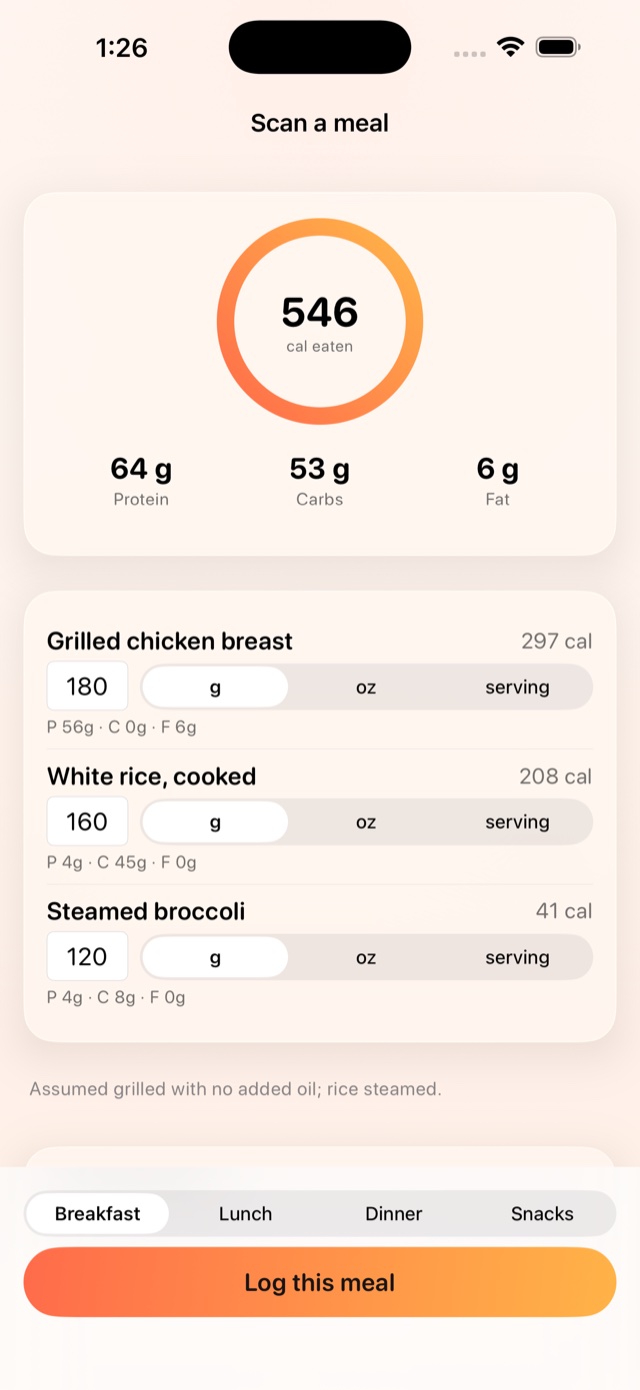
This is where Bocco fits into a fasting routine without turning it into another chore: a photo during your eating window gives you calories and macros in seconds, so checking in doesn't compete with the whole point of IF — eating less often, not tracking more often. If a portion looks off, you correct it in a sentence and the numbers recalculate, instead of guessing all evening. It won't tell you whether 16:8 or 5:2 suits you better, though — that part's still trial and error.
A sample 16:8 day
- 12pm (break the fast): eggs, avocado toast, fruit — logged with a quick photo.
- 4pm: Greek yogurt and a handful of nuts.
- 8pm (last meal): chicken, rice, vegetables, olive oil — logged the same way.
- 8pm–12pm next day: water, black coffee, tea. Nothing to log.
Two logged meals, not twenty. Enough to know if the window is actually landing in a deficit.
Frequently asked questions
Does intermittent fasting work without counting calories?
It can — a shorter eating window often cuts calories automatically, without deliberate tracking. But if your weight isn't moving after a few consistent weeks, calories are still the thing worth checking.
What's the best intermittent fasting schedule for weight loss?
Whichever one you'll actually keep doing. 16:8, 5:2, and alternate-day approaches perform similarly in research once the resulting calorie deficit is accounted for — the schedule is a tool for adherence, not a separate lever on its own.
Can I eat as much as I want during my eating window?
You can eat more freely than on a scheduled diet, but a shorter window doesn't cancel calories — overeating during it can erase the deficit the fast built.
Do I need to log every meal while fasting?
No. A quick estimate at each meal in your window is enough to catch a pattern; you don't need gram-perfect numbers, just visibility into whether the window is actually landing where you think it is.
This article is for general information only and isn’t medical advice. For guidance about your own health, talk to a doctor or registered dietitian.