Reverse dieting: what it actually is (and how to do it)
By the Bocco team · 7 min read
The short version: reverse dieting is raising your calories slowly and deliberately after a diet — usually by 50–100 calories a week — instead of jumping straight back to your old eating habits. The goal isn't to "eat whatever you want again." It's to get back to maintenance calories without the fast weight regain that tends to follow a hard diet.
Here's what's actually going on, what the evidence supports, and how to do it without guessing.
Why people do this instead of just eating more
After weeks or months of eating less, your body doesn't just snap back to normal the moment you stop dieting. It's been adjusting — quietly lowering the amount of energy you burn at rest, turning down some hunger-regulating hormones, and nudging you to move a little less without noticing. Researchers call this metabolic adaptation, and it's measurable: a 2021 study in Nutrition & Metabolism tracking people on low-energy diets found that every extra 50 kcal/day of metabolic adaptation was linked to about 0.5 kg less weight and fat loss for the same diet (Martins et al., NIH/NCBI).
Go from a 1,600-calorie diet straight to 2,400 calories in one day, and you're eating well above what your (temporarily slower) metabolism is burning. Some of that shows up as fat gain almost immediately — not because 800 extra calories is inherently dangerous, but because it lands on a body that's still running leaner than it was before the diet started. Reverse dieting's pitch is that going up gradually gives your metabolism room to catch up before the calories do.
Does reverse dieting actually work? The honest answer
Here's where we have to be straight with you: metabolic adaptation is well-documented science. Reverse dieting as a specific protocol is not. It's a technique that grew out of competitive bodybuilding prep, and there's very little controlled research testing whether a slow calorie ramp genuinely preserves more metabolic rate than simply returning to maintenance and eating normally.
A registered dietitian interviewed by Today's Dietitian put it plainly: reverse dieting is useful as a structured way to land at a stable, no-longer-losing-no-longer-gaining calorie level after a diet — but the "metabolism boost" framing oversells what's actually happening (Today's Dietitian). What it reliably does is slow you down enough to notice the scale, your hunger, and your energy before you overshoot. That's a real, useful thing — it's just not magic, and it's not going to "fix" a metabolism that isn't actually broken in the first place.
How to reverse diet, step by step
- Know your starting point. Log what you're actually eating right now, at the end of your diet — not what your plan says you should be eating. Most people are drifting a bit either way by the last week or two.
- Add calories weekly, not daily. A common approach is +50 to +100 calories per week, mostly from carbohydrates (they're the macro people cut hardest during a diet, and they respond fastest to the extra energy in the gym).
- Watch three things, not just the scale: body weight (weekly average, not daily swings), energy levels, and hunger. If weight climbs faster than about 0.5–1% of body weight per week and keeps climbing after two weeks at the same intake, hold calories flat for a week before adding more.
- Expect some water weight. Carbs pull water into your muscles (glycogen binds water roughly 3:1). A 2–4 lb jump in the first one to two weeks is very often water, not fat — don't panic and cut calories back on day three.
- Keep going until you're at maintenance. For most people that's somewhere between 6 and 12 weeks of gradual increases, depending on how aggressive the diet was and how long it ran.
Who this is for — and who should skip it
Reverse dieting makes the most sense after a longer, more aggressive cut (think 12+ weeks at a meaningful deficit) where you're worried about rebound bingeing or fast fat regain. If you did a short, mild diet — a few weeks at a modest deficit — you can usually just go back to normal eating over a week or two and skip the ceremony.
It's also not a substitute for addressing disordered eating patterns. If food anxiety, bingeing, or an inability to stop counting calories is part of the picture, that's worth talking to a doctor or registered dietitian about directly — a calorie protocol won't fix it.
Where logging accuracy actually matters here
This is the one phase of tracking where sloppy logging costs you the most. A 100-calorie weekly increase only means something if last week's number was close to accurate — round every meal down "a little" and you can eat your way through several planned increases without meaning to.
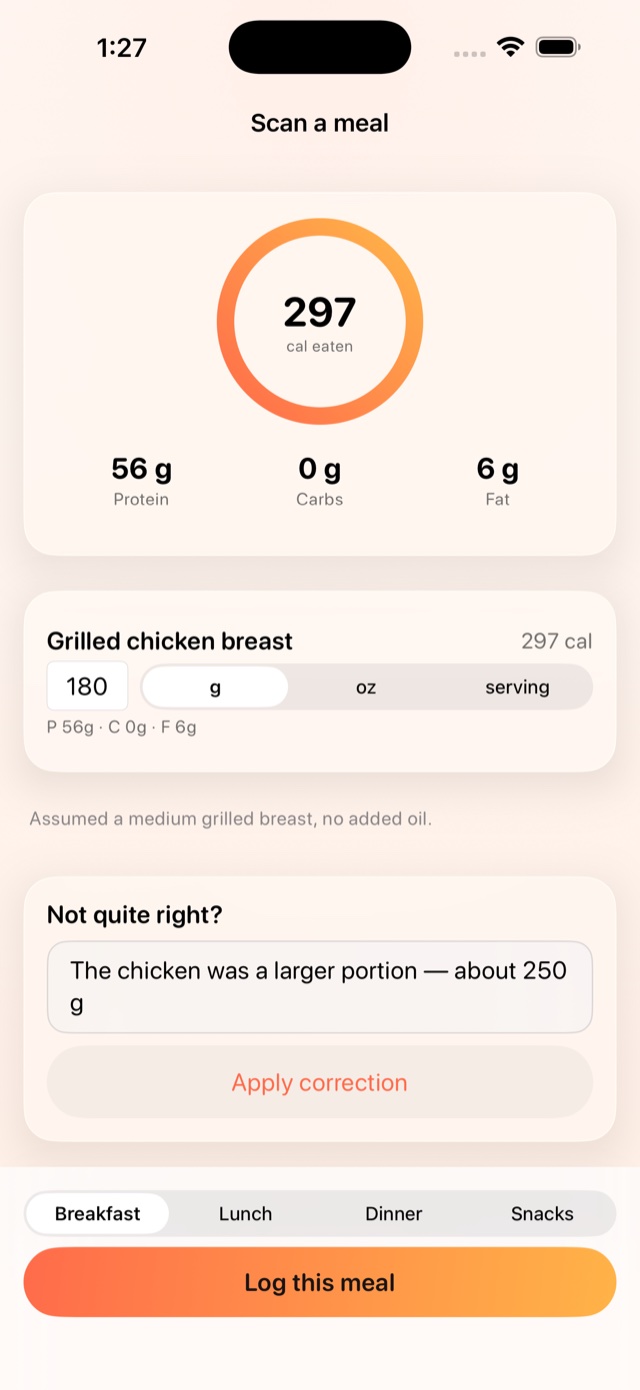
This is exactly where Bocco earns its keep: snap a photo, get calories and macros back in seconds, and if the portion looks off, correct it in a sentence ("smaller bowl than usual") and the numbers recalculate properly. Reverse dieting isn't about being perfect — it's about being consistent enough to actually see the +50 calories you added, not lose it in the noise.
Frequently asked questions
How long should a reverse diet take?
Most people spend 6–12 weeks gradually raising calories back to maintenance, depending on how long and how aggressive the prior diet was. Shorter, milder diets need less time.
Will reverse dieting definitely boost my metabolism?
No — be skeptical of that framing. It won't create extra metabolism that wasn't there before dieting; it mainly helps you land back at maintenance without overshooting into fast fat regain, and it gives your body time to reverse the adaptation that happens during any calorie deficit.
Is the weight gain in the first week fat?
Usually mostly water. Carbohydrate intake pulls water into muscle glycogen stores, so a jump on the scale in week one is rarely pure fat — give it two to three weeks before judging the trend.
Do I need to reverse diet after every diet?
No. It's most useful after longer, harder cuts. After a short or mild deficit, most people can return to normal eating over a week or two without a formal ramp-up.