Weight loss plateau: why it happens (and what actually works)
By Artem Grebenkin, founder of Bocco · · 6 min read
The short version: a weight-loss plateau is when the scale stops trending down for two or three weeks straight, even though you haven't consciously changed anything. It's rarely your metabolism "breaking." The far more common story is a few small habits quietly drifting back in — a bit less precise logging, a bit less daily movement — until they cancel out the deficit that was making you lose weight in the first place. The fix isn't a dramatic overhaul. It's tightening the same tracking that got you here, then making one deliberate change and giving it enough time to actually show up on the scale.
Here's what's really going on, and what's worth trying, in order.
What actually counts as a plateau (not just a slow week)
Your weight moves day to day for reasons that have nothing to do with fat loss: sodium, hormones, how much food is currently in your gut, water retention from a hard workout. A single flat week, or even a week where the number ticks up, isn't a plateau — it's noise.
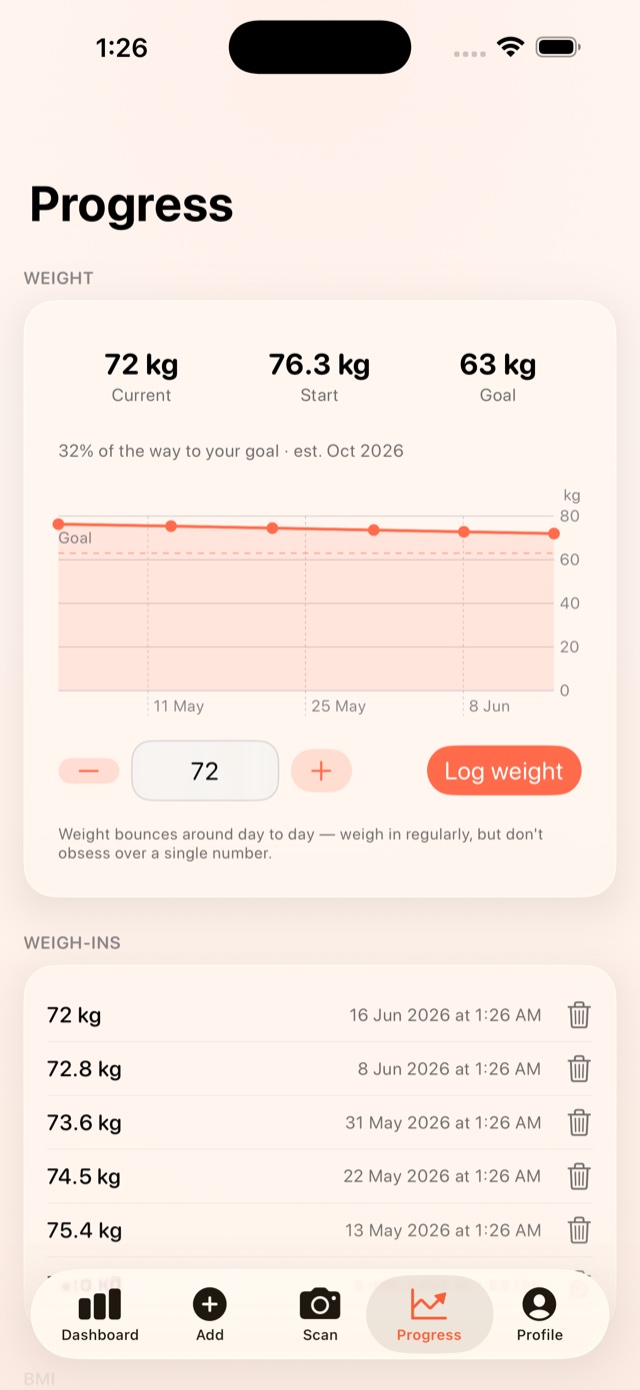
A real plateau is when your weekly average stops trending down for two to three weeks in a row, while you're still eating and moving roughly the way you were when the number was falling. That's the point worth investigating. Before then, you're probably just looking at normal fluctuation and reacting to it too early.
Your metabolism probably isn't the problem
It's tempting to blame a "broken" or "adapted" metabolism, and there's a real phenomenon behind that instinct: as you lose weight, you lose some muscle along with fat, and muscle is metabolically active tissue. A lighter body with less muscle burns somewhat fewer calories at rest than it used to — that's real, and it's part of why the same calorie target that worked at your starting weight eventually stops working (Mayo Clinic).
But that decline is usually gradual, not the sudden wall people describe when they hit a plateau after a few good weeks. A 2014 mathematical modeling study in the American Journal of Clinical Nutrition tested this directly, running the numbers across several large datasets, and concluded that an intermittent lack of diet adherence — not metabolic adaptation — is the major driver of the early plateau most people run into (Thomas et al., NIH/PMC). In plain terms: for most people, in the first few months, the boring explanation beats the dramatic one. Something in the routine slipped, even slightly, before the metabolism did.
That's not a criticism — it's actually good news. A slipped habit is fixable this week. A "broken" metabolism sounds like something you can't do anything about.
Where the calories quietly come back
None of this usually happens on purpose. A few of the most common leaks:
- Portions loosen. The careful weighing or photo-logging from week one fades into looser eyeballing by week six, and eyeballing drifts upward, not down.
- Daily movement drops. NEAT — the walking, fidgeting, and standing you do outside of workouts — tends to fall during a diet without you noticing, quietly lowering how much you burn.
- Weekend eating creeps. One extra glass of wine or a bigger restaurant portion on Friday and Saturday can erase several days of a careful deficit.
- "Earned it" eating after exercise. A hard gym session can make an extra snack feel justified, even when the workout itself burned less than the snack adds back.
Individually these are tiny. Stacked over a few weeks, they're enough to flatten a trend that was working fine a month earlier.
What to actually do about it
In order — try these before assuming you need a completely different plan:
- Re-tighten logging for one to two weeks before changing anything. Go back to logging the way you did in week one — every meal, honestly, including the "small" stuff. Often the plateau explains itself once the numbers are accurate again.
- Recalculate your target at your current weight. A calorie target set for your starting weight is too high for a body that's now smaller. If you haven't updated the math in a while, that alone can be the whole story.
- Add movement before cutting calories further. A daily walk or a standing desk does more for a stalled trend than shaving another 100 calories off an already-tight plan — and it's easier to sustain.
- Give any change two to three weeks before judging it. Water-weight swings can hide a real trend for a week or more. Reacting after three days means reacting to noise.
- Consider a short break at maintenance if you've been dieting for a long time. A week or two eating at maintenance calories won't "reset" your metabolism, but it can ease the adherence fatigue that's often the actual cause — see our reverse dieting guide for how to do that step without overshooting.
When it's more than adherence
If you've genuinely tightened logging, updated the target, and given it three-plus weeks with nothing moving, it's worth looking past food: poor sleep and chronic stress both raise cortisol and appetite, and can quietly push daily movement down the same way dieting does. That's a reasonable point to loop in a doctor or registered dietitian, especially if a plateau drags on for a month or more.
This is also where accurate logging matters most, and it's the part where Bocco earns its keep. A photo gets you calories and macros in seconds, and if a portion looks off, correcting it in a sentence — "bigger bowl than usual" — recalculates the numbers instead of just relabeling them. When you're trying to figure out whether a plateau is real or just sloppy tracking, the accuracy of the log is the whole question.
Frequently asked questions
How long is a normal weight-loss plateau before I should do something?
Give it two to three weeks of a flat weekly average, with consistent logging, before changing your approach. Shorter than that is usually just normal fluctuation.
Does eating well below my target break the plateau faster?
Usually not — a sharp cut tends to backfire through hunger, worse adherence, and more muscle loss. A small, deliberate change you can sustain works better than a drastic one you can't.
Can stress or poor sleep cause a plateau?
Yes, indirectly. Both can raise appetite and cortisol and quietly lower how much you move day to day. Worth ruling out if logging and calories both check out.
Should I cut calories further the moment I hit a plateau?
Not immediately. Re-tighten your logging and recalculate your target at your current weight first — that resolves a lot of plateaus on its own.
This article is for general information only and isn’t medical advice. For guidance about your own health, talk to a doctor or registered dietitian.