How to read a nutrition label (without the confusion)
By the Bocco team · 6 min read
The short version: ignore most of the label. Start with the serving size (are you actually eating one, or three?), check the calories for that serving, then glance at % Daily Value — 5% or less is low, 20% or more is high, per the FDA's own rule of thumb. That covers most real decisions. Everything else on the label is there for the 10% of the time you need it.
Here's how the label actually breaks down, and where people usually get tripped up.
Start with servings per container — this is where most people get it wrong
The single most common label mistake isn't math. It's assuming the numbers on the label describe the whole package, when they almost always describe one serving.
A bag of chips that looks like "one snack" might legally be 2.5 servings. Drink the whole 20-oz soda bottle and you've had 2.5 times the calories and sugar printed at the top of the label, because the bottle is "2.5 servings," not one. Before you read a single number, check two things: how big is a serving, and how many servings are actually in what you're about to eat.
Calories: per serving, not per package
Once you know the serving size, the calorie number makes sense. It's calories for that one serving — multiply by however many servings you're having.
This is also where "healthy" snacks quietly outmaneuver you. A granola bar at 90 calories sounds great, until you notice the label is based on half a bar. Eat the whole thing (most people do) and it's 180. Not a scandal, just arithmetic worth doing once before you decide a food is "light."
% Daily Value: the shortcut that does most of the work
Percent Daily Value (%DV) tells you how much a nutrient in one serving contributes to a general daily target — based on a 2,000-calorie diet, whether or not that's your actual number. You don't need to calculate anything. The FDA's own guidance gives a fast rule: 5% DV or less per serving is low, 20% DV or more is high.
Use it as a scanner, not a spreadsheet: high %DV on fiber or protein is usually a point in a food's favor; high %DV on sodium or saturated fat is worth noticing before you eat the whole bag. It's not a verdict on any single food — a food can be worth eating even with a high number on one line — but it's the fastest way to compare two products without doing any math.
Added sugars vs. total sugars — the line most people skip
"Total sugars" includes everything: sugar that's naturally in the food (the lactose in plain yogurt, the fructose in an apple) plus anything a manufacturer added. "Added sugars" is its own separate line underneath it, and it's the one worth actually reading.
A plain Greek yogurt might show 6g of total sugars — all naturally occurring, 0g added. A flavored yogurt next to it can show 6g total sugars too, but with 5g of that added during processing. Same total-sugars number, very different food. The FDA requires added sugars as its own line specifically because "total sugars" alone hides this.
The ingredient list: ordered by weight, not by importance
Ingredients are listed from most to least, by weight. If sugar (in any of its many names — cane sugar, corn syrup, dextrose) shows up in the first three ingredients, it's a meaningful part of the product, whatever the front-of-package marketing says. This is the one part of the label that's genuinely unstandardized — no %DV, no serving math — so it rewards just reading it, top to bottom, once.
A worked example: two granola bars, side by side
- Bar A: serving size = 1 bar (35g), 140 calories, 6% DV saturated fat, 8g added sugars.
- Bar B: serving size = ½ bar (17g), 90 calories, 3% DV saturated fat, 5g added sugars.
At a glance, Bar B looks "lighter." Eat the whole bar, though (which almost everyone does), and it's 180 calories and 10g added sugars — worse than Bar A on both counts. The label isn't lying about either bar. It's just describing a serving size the packaging design quietly discourages you from noticing.
How Bocco helps
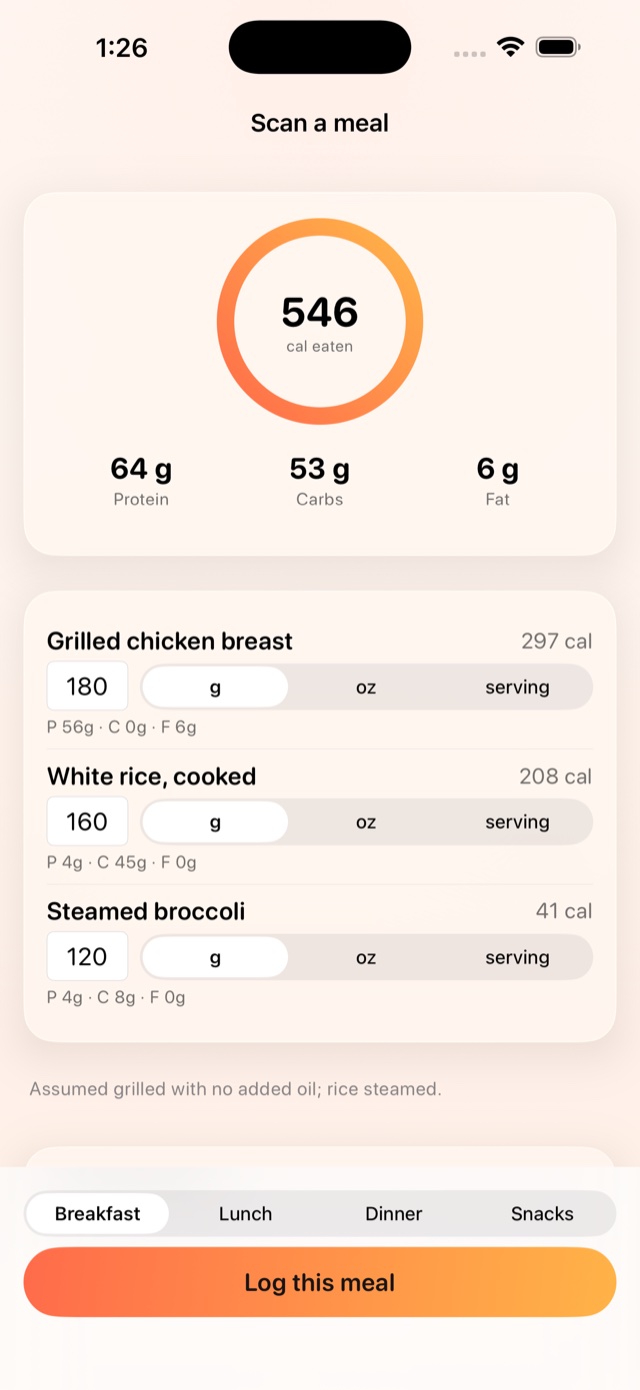
This is exactly the kind of math we built Bocco to skip. Snap a photo of a meal or a label and it reads the numbers, does the per-serving arithmetic, and gives you a total — no squinting at 6-point font or multiplying by 2.5 servings in your head. If a portion looks off, you correct it in plain words and the numbers recalculate. It's still your judgment call on what to eat; it just removes the arithmetic from the equation.
Frequently asked questions
What's the difference between serving size and servings per container?
Serving size is the amount one portion is based on; servings per container tells you how many of those portions are in the whole package. The calories and other numbers on the label are per serving, not per package, unless the two happen to be equal.
Is 20% Daily Value a lot?
Yes — the FDA's own rule of thumb is 5% DV or less is low, 20% DV or more is high. Use it to spot a nutrient-dense pick fast, without doing any math.
What's the difference between "sugars" and "added sugars" on the label?
Total sugars include naturally occurring sugar (like the sugar in plain milk or fruit) plus anything added during processing. Added sugars is the one worth watching — it's the number a food maker chose to add.
Do I need to read every line on the label?
No. Serving size, calories, and % Daily Value on the nutrients you're tracking cover most decisions. The rest is there for when you need it.
Sources: FDA, How to Understand and Use the Nutrition Facts Label. FDA, Added Sugars on the Nutrition Facts Label.