How many calories are in a gram of protein?
By Artem Grebenkin, founder of Bocco · · 6 min read
The short version: a gram of protein is 4 calories. A gram of carbohydrate is also 4. A gram of fat is 9 — more than double either of the other two. These aren't rounded estimates someone made up for a diet book; they're the general calorie factors the FDA requires on every U.S. nutrition label, based on research from chemist Wilbur Atwater over a century ago and still used by USDA's own food database today. Multiply grams by these numbers and you can check any label's math yourself, or build your own from a recipe.
Here's where the numbers come from, and how to actually use them.
Where 4-4-9 actually comes from
The numbers aren't arbitrary. In the late 1800s, Wilbur Atwater at the USDA measured how much usable energy the body actually gets from protein, carbohydrate, and fat — after accounting for digestion losses and, for protein, the energy lost excreting nitrogen waste. His results rounded to 4 calories per gram for protein, 4 for carbohydrate, and 9 for fat. Those "Atwater general factors" are still what USDA's FoodData Central uses to calculate the energy values in its food composition database, identified there as "Metabolizable Energy (Atwater General Factor)."
They're not just a research convention, either — the FDA made them the law for how packaged food is labeled. Under 21 CFR 101.9(c)(1), the federal nutrition-labeling regulation, the general calorie factors are set at 4 calories per gram for protein, 4 for total carbohydrate, and 9 for total fat — the same numbers, decades later. So when a label says "Calories 210," that number was built from these three multipliers, not measured directly from that specific box of cereal in a lab that day.
Fat comes out over double the others because it's a denser fuel — more carbon-hydrogen bonds per gram, less oxygen already baked into the molecule, so it releases more energy when the body breaks it down. That's also why "low-fat" and "low-calorie" aren't the same claim: a food can cut fat and still be calorie-dense if it makes up the difference in sugar.
The conversion math, worked with real food
The formula is just multiplication, then addition:
(protein g × 4) + (carbs g × 4) + (fat g × 9) = total calories
A few real examples:
- A 6 oz grilled chicken breast — roughly 53g protein, 0g carbs, 7g fat → (53 × 4) + (0 × 4) + (7 × 9) = 212 + 0 + 63 = 275 calories.
- 1 cup cooked white rice — about 4g protein, 45g carbs, 0.4g fat → (4 × 4) + (45 × 4) + (0.4 × 9) = 16 + 180 + 3.6 ≈ 200 calories.
- 1 tablespoon olive oil — 0g protein, 0g carbs, 14g fat → (0 × 4) + (0 × 4) + (14 × 9) = 126 calories, from fat alone.
- A full plate — that chicken, rice, and a drizzle of oil comes to roughly 275 + 200 + 126 = 601 calories — and that's the exact arithmetic a food label is doing behind the scenes, just done by machine instead of by hand.
Notice how much of the olive oil's calories come from a single tablespoon. That's the 9-calorie factor doing its work: fat is calorically dense enough that "just a drizzle" adds up faster than people expect, which is a common reason a meal comes in higher than someone guessed.
Alcohol is the fourth number nobody counts
Protein, carbs, and fat get all the attention because they're the three macros on every label. But alcohol has its own calorie factor too: 7 calories per gram — between carbs/protein and fat. It's not classified as a macronutrient (it provides no essential nutrients the body needs), so it doesn't get its own line on most labels, but the calories are real and they add to the day's total the same as anything else.
A standard 5 oz glass of wine (about 14g of alcohol) works out to roughly 14 × 7 = 98 calories from alcohol alone — before counting the sugar in a sweeter wine or the carbs in a beer. It's one of the most common reasons a tracked day feels "off" from the scale: the alcohol calories were real, they just weren't logged anywhere.
How to check a nutrition label's own math
Labels round each macro to the nearest gram before printing it, and round the final calorie count too — so the numbers on a package won't always multiply out to exactly the printed total. That's normal, not a labeling error, as long as it's close.
Try it on any label you have nearby: take the grams of protein, carbs, and fat, run them through the formula above, and compare the result to the printed "Calories" line. If your number lands within about 10–20 calories of theirs, the rounding explains the gap. If it's off by 50+ calories, something's usually wrong with how the serving size or macros were entered — worth double-checking before you log it.
Why this matters for tracking macros
This is also the math underneath every macro percentage you've seen quoted — "a 40/30/30 split," "30% of calories from protein." Those percentages are just this formula run in reverse: someone picked calorie targets for each macro, then divided by 4, 4, or 9 to get the grams. If you're setting your own macro targets, how to track macros walks through that conversion step by step.
It's also why gram totals alone can be misleading without context. 30g of protein and 30g of fat sound like a similar amount of food, but they're not close in calories — 120 versus 270. When you're reading a nutrition label, the calorie line and the macro grams are telling two different parts of the same story, and it's worth knowing how they connect.
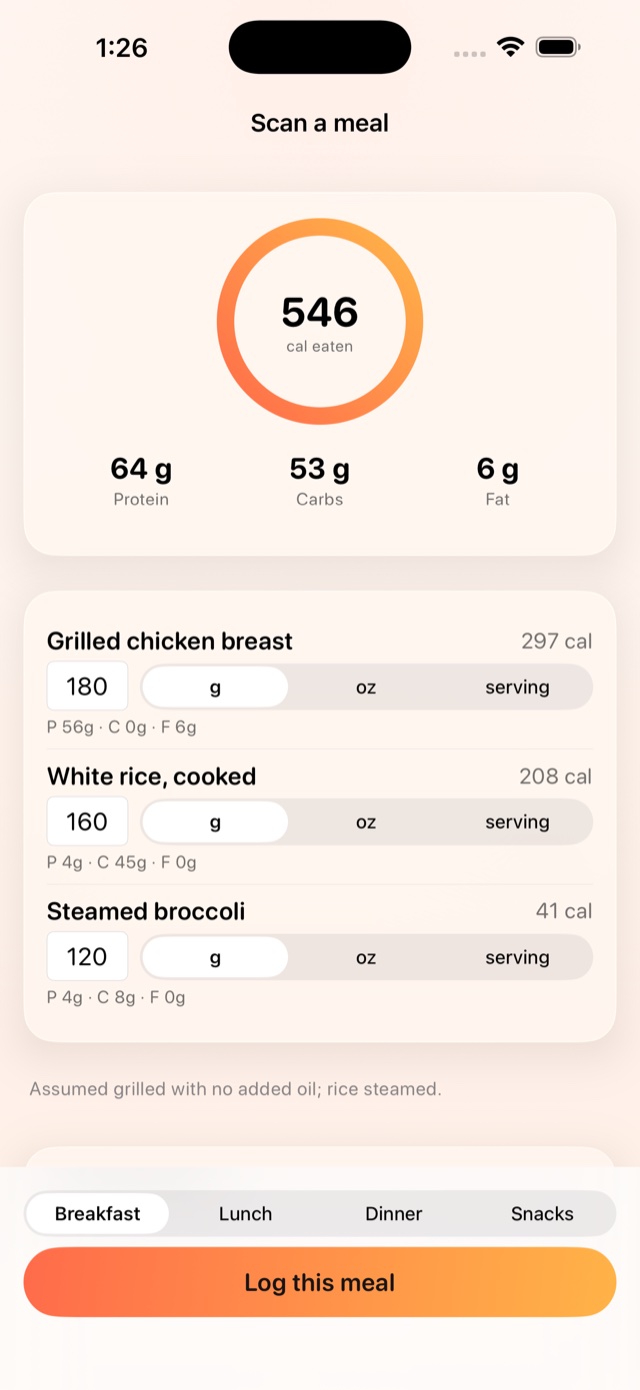
I built the total-recalculation logic in Bocco around this formula on purpose — when you correct a portion or ingredient, the app doesn't just guess a new number, it re-derives the total from the actual grams, the same 4-4-9 math above. Snap a photo, and it estimates the grams of protein, carbs, and fat, then does this exact arithmetic for you. If a portion looks off, you fix it in a sentence and the totals recalculate honestly instead of drifting.
Frequently asked questions
How many calories are in 1 gram of protein?
4 calories, per the FDA's general calorie-calculation rule (21 CFR 101.9) and USDA's Atwater general factors — the same figure used on every U.S. nutrition label.
How many calories are in 1 gram of carbs?
Also 4 calories — the same factor as protein, even though carbs often get blamed for calories that, gram for gram, are identical to protein's.
How many calories are in 1 gram of fat?
9 calories — more than double protein or carbs, which is why fat-heavy additions like oil, butter, and cheese raise a meal's calorie count fastest.
Is alcohol a macronutrient?
No — it's not classified as one of the three macros — but it still carries calories: about 7 per gram, between carbs/protein and fat.
How do I convert grams of protein, carbs, and fat into a calorie total?
Multiply protein and carb grams by 4, fat grams by 9, and add the three together. That sum should land close to the label's printed calorie count, within normal rounding.
This article is for general information only and isn’t medical advice. For guidance about your own health, talk to a doctor or registered dietitian.